
Biological Science Faculty Member - Retired
Dr. Thomas E. Miller
- Office: 4022 King Life Sciences
- Office: (850) 644-9823
- Area: Ecology & Evolution
- Lab: King Life Sciences
- Lab: (850) 644-9823
- Fax: (850) 645-8447
- Mail code: 4295
- E-mail: miller@bio.fsu.edu
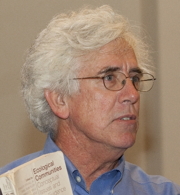
Professor
Ph.D., Michigan State University, 1985
As a community ecologist, I am interested in what controls the diversity and abundance of species in different ecosystems. But, I am open to exploring different questions within this broad area. Until 2026, I taught General Ecology (PCB 3043), as well as several graduate courses. I am now retired from teaching, but plan on continuing with research for several more years. I am no longer taking applications for graduate students in my lab.
Research and Professional Interests:
My current research program is divided into two very different areas. (1) Coastal Dune Vegetation: I am interested in the forces that structure plant communities on barrier island, especially in the northern Gulf of Mexico. We have been using a long-term study of the vegetation on St. George Island to understand the relative importance of hurricanes, drought, geomorphology, and succession on determining patterns of individual species abundance and community diversity through time, with a particular interest in looking at restoration and climate change. (2) Evolution of Protozoa in Pitcher Plants: We have been using models and experiments to ask questions about how suites of competitors evolve though time. Because of their unique microhabitats and short generation times, protozoa found in the water-filled leaves of pitcher plants are an ideal system to conduct selection experiments, looking at how competing species evolve and, ultimately, how diversity itself affects the evolution in multi-species assemblages. My former students were not tied work in my systems and questions and have explored a variety of areas, including plant invasion biology, metacommunities, and range-shifts in response to climate change.
Selected Publications:
Miller, T. E., & Cuellar-Gempeler, C. (in revision). Experimental tests of the combined effects of heterogeneity and dispersal in a metacommunity. Ecology. Manuscript submitted for publication.
Cuellar-Gempeler, C., terHorst, C., & Miller, T. E. (2025). Opposing effects of succession on bacterial diversity and function result in negative biodiversity-function relationships within pitcher plant (Sarracenia purpurea) leaves. Ecology.
Pilipczak, N. C., & Miller, T. E. (i2025). The Timing of Nectar Production in Leaves of the Purple Pitcher Plant, Sarracenia purpurea. Southeastern Naturalist.
Moore, L., Hacker, S., Breithaupt, J., deVries, S., Miller, T. E., Ruggiero, P., & Zinnert, J. (2025). Ecomorphodynamics of coastal foredune evolution. Nature Reviews Earth & Environment.
Miller, T. E., Pastore, A., Cuellar-Gempeler, C., Cantor, E., & Mason, O. (2023). Effects of community richness and competitive asymmetry on protozoa evolution in Sarracenia purpurea leaves. American Naturalist, 200, 691-703. doi:https://doi.org/10.1086/721010
Cuellar-Gempeler, C., terHorst, C., Mason, O., & Miller, T. E. (2022). Predator dispersal in pitcher plant microbial metacommunities influences predator distribution but not prey diversity. Ecology. doi:DOI: 10.1002/ecy.3912
Miller, T. E., & Cooper, G. (2022). Competition, Coexistence, and Extinction. In Thomas E. Miller, & Joseph Travis (Eds.), Foundations of Ecology II (pp. 151-162). University of Chicago.
Miller, T. E., & Bascompte, J. (2022). Incorporating Trophic and Spatial Structure. In Thomas E. Miller, & Joseph Travis (Eds.), Foundations of Ecology II (pp. 397-407). University of Chicago. .
Miller, T. E., & Travis, J. (Eds.). (2022). Foundations of Ecology II [edited book]. University of Chicago.
Rodriguez, Z., Holdridge, E., & Miller, T. E. (2022). Understanding spatially complex cryptic coloration in the Green Lynx Spider Peucetia viridans. Ecological Entomology, 47, 481-487. doi:https://doi.org/10.1111/een.13132
Travis, J., Miller, T. E., & Rodd, H. (2022). General Introduction. In Thomas E. Miller, & Joseph Travis (Eds.), Foundations of Ecology II (pp. 1-10). University of Chicago.
Vogel, M., Mason, O., & Miller, T. E. (2021). Composition of seagrass microbial phyllosphere communities suggests rapid environmental regulation of community structure. FEMS Microbiology Ecology, 97. doi:10.1093/femsec/fiab013
Pastore, A., Barabas, G., Bimler, M., Mayfield, M., & Miller, T. E. (2021). The evolution of niche overlap and competitive differences. Nature Ecology and Evolution, 5. doi:10.1038/s41559-020-01383-y
Vogel, M., Mason, O., & Miller, T. E. (2020). Host and environmental determinants of microbial community structure in the marine phyllosphere. PLoS One, 15, e0235441. doi:10.1371/journal.pone.0235441
Green, M. D., and T. E. Miller. 2019. Germination traits explain deterministic processes in the assembly of early successional coastal dune vegetation. Estuaries and Coasts 42:1097-1103. doi:https://doi.org/10.1007/s12237-019-00550
Miller, T. E., M. Buhler, and C. Cuellar-Gempeler. 2019. Species-specific differences determine responses to a resource pulse and predation. Oecologia. doi:https://doi.org/10.1007/s00442-019-04393
Ryan, W. H., and T. E. Miller. 2019. Reproductive strategy changes across latitude in a clonal sea anemone. Marine Ecology Progress Series 611:129-141. doi:https://doi.org/10.3354/meps12862
Canter, E., C. Cuellar-Gempeler, A. Pastore, T. E. Miller, and O. Mason. 2018. Predator identity more than predator richness structures aquatic microbial assemblages in Sarracenia purpurea leaves. Ecology, 99, 652-660. doi:https://doi.org/10.1002/ecy.2128.
Ryan, W. H. 2018. Seasonal patterns and geographic variation in temperature dependent fission rate plasticity in a clonal sea anemone. American Naturalist, 191, 210-219.
Savage, C., and T. E. Miller. 2018. A test of group foraging by the carnivorous plant, Sarracenia flava: are pitcher plants like wolves? American Midland Naturalist, 179, 78-85. doi:https://doi.org/10.1674/0003-0031-179.1
terHorst, C. P., P. C. Zee, K. D. Heath, T. E. Miller, A. I. Pastore, S. Patel, S. J. Schreiber, M. J. Wade, and M. R. Walsh. 2018. Evolution in a community context: Trait responses to multiple species interactions. American Naturalist, 191, 1-13.
Ryan, W. H., E. Gornish, L. Chrstenson, S. Halpern, S. Hendersn, G. LeBuhn, and T. E. Miller. 2017. A toolbox for initiating and managing long-term data collections with students and citizen scientists. American Biology Teacher 79:28-34. doi:10.1525/ABT.2017.79.1.28
Reid, R. Y. Luc, S. Yan, T. Miller, and B. Song. 2016. Transcriptome dataset of halophyte beach morning glory, a close wild relative of sweet potato. Frontiers in Plant Science 7:1267. doi:10.3389/fpls.2016.0126
Gray, S., T. Poisot, E. Harvey, N. Mouquet, T. Miller, and D. Gravel. 2016. Temperature and trophic structure are driving microbial productivity along a biogeographic gradient. Ecography 39:981-989. doi:10.1111/ecog.01748
Miller, T. E. 2015. Effects of disturbance on vegetation by sand accretion and erosion across coastal dune habitats on a barrier island. AoB Plants 7: plv003. doi: 10.1093/aobpla/plv003
Gornish, E. S., and T. E. Miller. 2015. Plant community responses to simultaneous changes in temperature, nitrogen availability, and invasion. PlosOne DOI: 10.1371/journal.pone.0123715.
Miller, T. E., E. Moran, and C. P. terHorst. 2014. Rethinking niche evolution: experiments with natural communities of protozoa in pitcher plants. American Naturalist 184:277-283.
Paisie T. K. , T. E. Miller, O. U. Mason. 2014. Effects of a ciliate protozoa predator on microbial communities in pitcher plant (Sarracenia purpurea) leaves. PLoS ONE 9(11):e113384. doi:10.1371/journal.pone.0113384
Pastore, A. I., C. M. Prather, E. S. Gornish, W. H. Ryan, R. D. Ellis, and T. E. Miller. 2014. Testing the competition–colonization trade-off with a 32-year study of a saxicolous lichen community. Ecology 2014 95:306-315
Gornish, E. S., and T. E. Miller. 2013. Using long-term census data to inform restoration methods for coastal dune vegetation. Estuaries and Coasts 36:1014-1023.
Baiser, B., N. J. Gotelli, H. L. Buckley, T. E. Miller, and A. M. Ellison. 2012. Geographic variation in network structure of a nearctic aquatic food web. Global Ecology and Biogeography: 21:579-591.
Kadowaki, K., B. D. Inouye, and T. E. Miller. 2012. Assembly-history dynamics of a pitcher-plant protozoan community in experimental microcosms. PLoS ONE 7: e42651. doi:10.1371/journal.pone.0042651. PDF
Miller, T. E. and C. P. terHorst. 2012. Testing successional hypotheses of stability, heterogeneity, and diversity in pitcher-plant inquiline communities. Oecologia 170:243-251. PDF