
Biological Science Faculty Member - Retired
Dr. Kimberly A. Hughes
- Office: 4062 King Life Sciences
- Office: (850) 645-8553
- Area: Ecology & Evolution
- Lab: King Life Sciences
- Lab: (850) 645-8554
- Fax: (850) 645-8447
- Mail code: 4295
- E-mail: kahughes@bio.fsu.edu
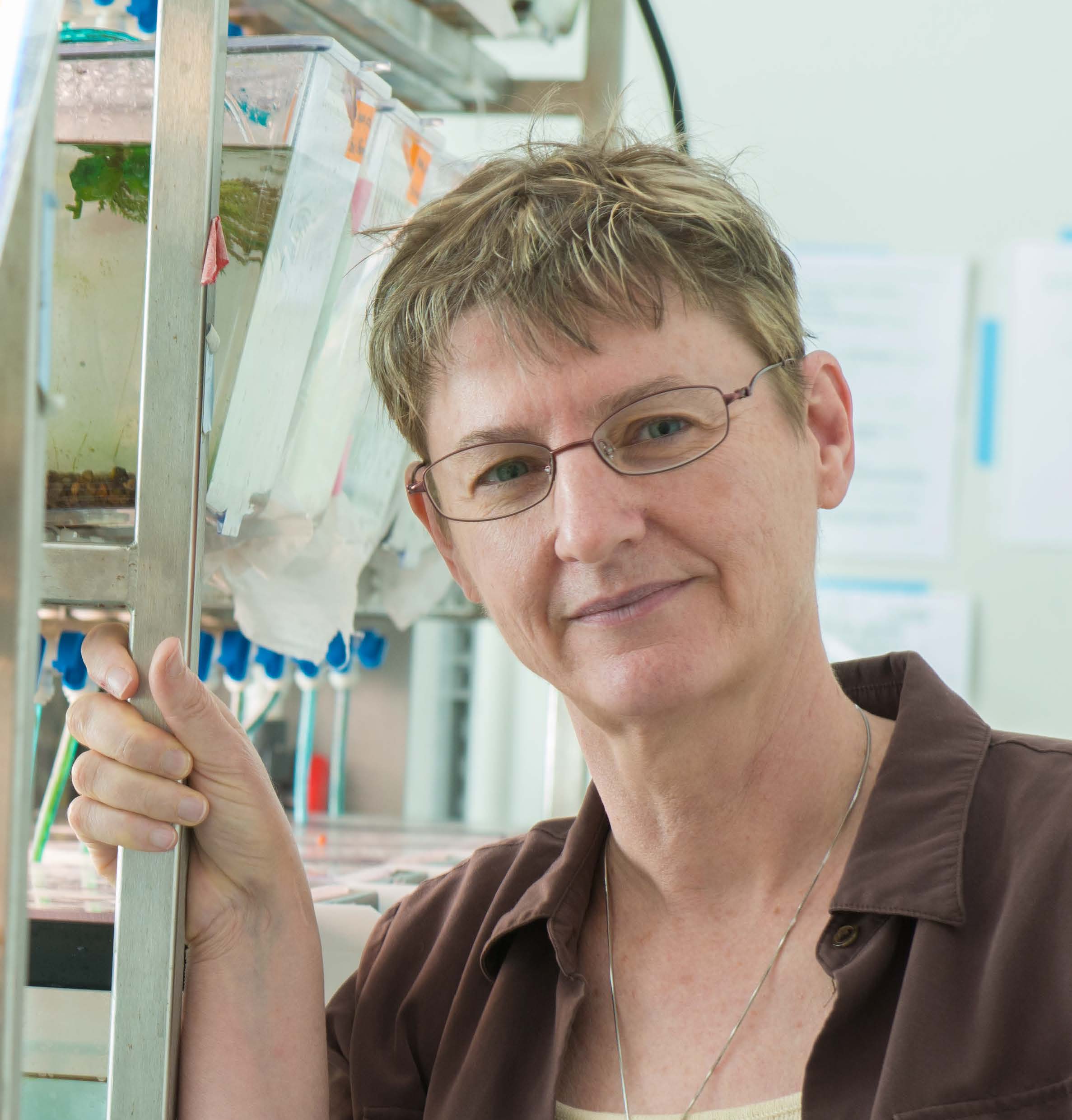
Professor
Ph.D., University of Chicago, 1993
Research and Professional Interests:
Organisms are enormously genetically diverse. Even traits under strong natural selection, such as fertility, longevity, and reproductive behavior can vary greatly among individuals within a single population, and much of this variation can be heritable. We strive to understand why so much genetic variation persists for traits under strong selection and also to understand the consequences of this diversity for individuals, species, and communities. Members of the lab are studying the genetic, genomic, and evolutionary determinants of life span; the ecological genetics of sexual selection and mate choice; and genetic and social modifiers of growth, behavior, and fitness. We use different experimental organisms, including fruit flies and several species of poeciliid fish, and a diversity of techniques, including quantitative genetics, evolutionary and behavioral genomics and field studies.
Selected Publications:
Cullumber, Z, Engel, N, Travis, J, Hughes, KA. 2019. Larger female brains do not reduce male sexual coercion. Animal Behav In press.
Valvo, JJ, Rodd, FH, Hughes, KA. 2019. Consistent female preference for rare and unfamiliar male color patterns in wild guppy populations. Behavioral Ecology, Online ahead of press: https://doi.org/10.1093/beheco/arz134.
Daniel, MJ, Koffinas, L, Hughes KA. 2019. Habituation underpins preference for mates with novel phenotypes in the guppy. Proceedings of the Royal Society B 286:20190435.
Kelly JK, Hughes KA, 2019. Pervasive linked selection and intermediate-frequency alleles are implicated in an evolve-and-resequencing experiment of Drosophila simulans. Genetics 211:943-961. doi: 10.1534/genetics.118.301824.
Culumber ZW, Kraft B, Lemakos V, Hoffner E, Travis J, Hughes KA, 2018. GxG epistasis in growth and condition and the maintenance of genetic polymorphism in Gambusia holbrooki. Evolution 72:1146-1154. doi: 10.1111/evo.13474.
Kraft B, Lemakos VA, Travis J, Hughes KA, 2018. Pervasive indirect genetic effects on behavioral development in polymorphic eastern mosquitofish. Behavioral Ecology 29:289-300. doi: 10.1093/beheco/arx180.
Rittschof, C. C. and K. A. Hughes. 2018. Advancing behavioural genomics by considering timescale. Nature Commun 9:489.
Saltz JB, Bell AM, Flint J, Gomulkiewicz R, Hughes KA, Keagy J, 2018. Why does the magnitude of genotype-by-environment interaction vary? Ecology and Evolution 8:6342-6353. doi: 10.1002/ece3.4128.