
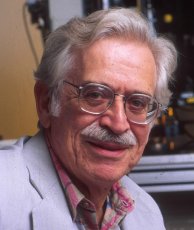
 In Memoriam
Dr. Donald L. D. Caspar, Professor Emeritus, 1927-2021
Ph.D., Yale University, 1955
Member of the National Academy of Sciences
About Dr. Caspar
Dr. Caspar's Wikipedia Page
Research and Professional
Interests:
How do protein molecules move to build complex structures, transmit and receive signals, activate substrates, do mechanical work, and perform a myriad of other functions? The mechanics of protein movements are currently being explored in my laboratory by means of structural studies on insulin and other protein crystals under a variety of conditions and on tobacco mosaic virus and polymorphic assemblies of its coat protein.
The Caspar and Klug quasi-equivalence theory of icosahedral virus construction was based on the recognition that structural proteins are adaptable molecules that can self-assemble by bonding together in different ways within a highly ordered structure. Studies on the DNA-containing tumor viruses have demonstrated that the molecular adaptability goes beyond the modest conformational adjustments anticipated in the quasi-equivalence theory; nevertheless essential bonding specificity is conserved in the contacts that tie the coat protein molecules together. As yet, there is no coherent picture of the switching mechanisms involved in the formation of any macromolecular biological assembly. Tobacco mosaic virus, which is the paradigm of a self-assembly structure, is the focus of renewed studies that investigate such structural switching. High-resolution data on the coat protein structure in different assemblies is being obtained by diffraction methods with synchrotron radiation and by cryoelectron microscopy, and the self-organization of liquid crystalline virus specimens is being studied with the methods of colloidal physics.
Crystals of well-characterized small proteins such as insulin and parvalbumin are serving as laboratories for investigating how atomic movements in proteins are correlated. Our studies on diffuse x-ray scattering demonstrate that the predominant components of the thermal fluctuations are correlated only over distances about the size of amino-acid side chains. Correlations in the movements of protein atoms coordinating metal atoms are being explored by novel diffraction methods with synchrotron radiation. Protein plasticity is dependent on the restrained mobility of the surrounding solvent. We are characterizing the ordering of the fluctuating solvent structure and the role of water in mediating structural alterations by crystallographic methods as the pH, ionic composition, and water activity of the solvent in cubic insulin crystals are varied.
The molecular movements involved in
tobacco mosaic virus assembly have much
in common with the movements the
insulin molecule must undergo when it
binds to its receptor. Piecing
together a picture of how protein molecules
in different systems can adapt
their conformations in performing their
biological functions is the
principal goal of this project. Realization of
this goal depends on our
methodological developments involving applications
of diffuse x-ray
scattering, high- and low-resolution x-ray and neutron
crystallography,
cryoelectron microscopy, fiber diffraction, and computer
graphics.

Tobacco mosaic virus particle and three views of the nucleating aggregate of its coat protein.
Selected Publications:
Diaz-Avalos, R., and D. L. D. Caspar. 1998 Structure of the stacked-disc aggregate of TMV Protein. Biophys. J. 74: 595-603.
Yu, B., and D. L. D. Caspar. 1998. Structure of cubic insulin crystals in glucose solution. Biophys. J. 74: 616-622.
Caspar, D. L. D. 1998. Bacterial flagellar coiling explained by slip-and-click strand switching. Nature Struct. Biol. 5: 92-94.
Yu, B., M. Blaber, A. M. Gronenborn, G. M. Clore, and D. L. D. Caspar. 1999. Disordered water within a hydrophobic protein cavity visualized by X-ray crystallography. Proc. Natl. Acad. Sci. USA 96: 103-108.
Twigg, P. D., G. P. Wylie, G. Wang, D. L. D. Caspar, J. R. Murphy, and T. M. Logan. 1999. Expression and assignment of the 1H, 15N, and 13C resonances of the C-terminal domain of the diphtheria toxin repressor. J. Biomol. NMR 13: 197-198.
Wang, G., G. P. Wylie, P. D. Twigg, D. L. D. Caspar, J. R. Murphy, and T. M. Logan. 1999. Solution structure and peptide binding studies of the C-terminal SH3-like domain of the diphtheria toxin repressor protein. Proc. Natl. Acad. Sci. USA 96: 6119-6124.
Diaz-Avalos, R., and D. L. D. Caspar. 2000. Hyperstable stacked-disk structure of tobacco mosaic virus protein: electron cryomicroscopy image construction related to atomic models. J. Mol. Biol. 297: 67-72.
Twigg, P., G. Parthasarathy, L. Guerrero, T. Logan, and D. L. D. Caspar. 2001. Disordered to ordered folding in the regulation of diphtheria toxin repressor activity. Proc. Natl. Acad. Sci. USA 98: 11259-11264.