Monday, 22 September 2025, Paris, Musée de la Marine, David Toutain
Written 1 February 2026
GOT 'EM! I had to stay up 'til 12:30 am to do it, but I snagged two free, 1:45-pm timed-entry tickets to get into Notre Dame cathedral on 24 September, our last day in Paris! Between 10,000 and 15,000 such tickets are made available each day, but they don't open up until midnight two days before, and they are taken by storm, always spoken for in the wee hours before dawn.
So last night, I stayed up until midnight and was on the website within seconds, only to encounter a screen saying that several hundred people were already there. Please wait an estimated 1 minute until the server had the capacity to deal with you. And, it added (in more polite terms), don't sit there hitting "refresh" every two seconds; this page refreshes on its own faster than you can do it. As I watched, the 1 minute went up to 3, then down to 2 again, back up to 3, then finally 2, 1, and I was in—about an 8-minute wait in all. Then I had to go through the process I'd already tried several times, so I knew the drill. By 12:30 am, I had secured our tickets. I prefer to present a paper QR or bar code (I tend to lose things on my phone), so I asked the hotel staff to print them. They wouldn't touch my flash drive for fear of viruses, but they were happy to accepted them by email and printed them out for me.
The next order of business was chocolates. We had promised to bring home chocolates for a friend, and we wanted some for ourselves, so I had Googled "chocolatier near me." I was delighted to learn that the great Alain Ducasse (a chef we're fond of) had a chocolate shop within walking distance of the hotel, at 40 rue de la Roquette! So I checked its opening hours and set off to stock up. Unfortunately, it was raining, so I donned by North Face waterproof jacket, drew up the hood and set off, dodging puddles all the way, as I didn't have any waterproof footgear with me.
I have no photos of the outing, because my hands were wet, and my camera was safe inside my purse, in turn sheltered by my jacket, and I didn't want to risk getting it wet. Too bad, since I encountered a charming phenomenon on the way—a couple of groups of preschoolers on their way somewhere. Each group was arrayed along the sides of a long strap of tough webbing, to which fabric handles had been stitched at intervals. An adult held each of its two ends, leading and trailing, and the little ones had clearly been instructed firmly never to let go of their assigned handles, so each group progressed along the sidewalk like a slow-moving centipede, concentrating hard on holding on or gazing wide-eyed at passing shop windows.
For photos of the shop, Google its website right up—"alain ducasse chocolate paris." Ducasse even had a cookie shop next door!
 But back to our excursion for the day. Just over a year ago, on 16 September 2024, we visited the Paris branch of the Musée de la Marine for the first time but didn't finish seeing it before our feet gave out. So I went on line this year and got tickets for the 2 pm time slot. Since David's injury, I've gone back and verified that yes, they do have portable folding seats.
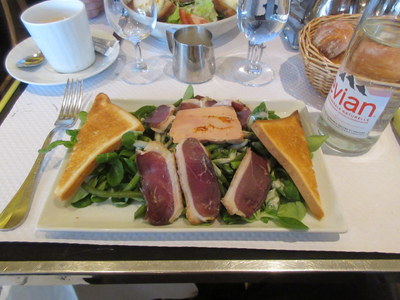
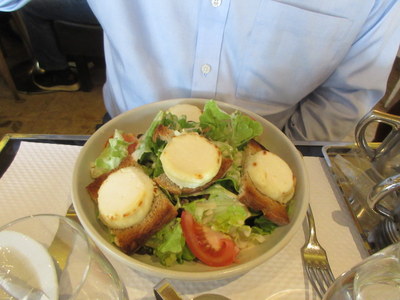
As we did last year, we had lunch at the Café Kleber, just across the Place du Trocadero from the museum. I ordered the salade Landaise that I enjoyed so much last year; if anything it was better this time because they left out the tomatoes. Once again, I ignored the ridiculous toast triangles and ate my pâté with baguette slices. David changed to the hot goat cheese salad this time; he got butter lettuce with a few leaves of bronze lettuce thrown in for contrast and four round pucks of goat cheese toasted on more of that sliced bread. As always, the creamy vinaigrette on the salads was terrific, as were the crisp, sweet, cold cooked green beans on mine.
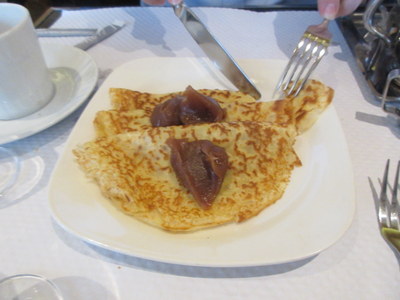
 For dessert, we split another plate of crème de marron crêpes.
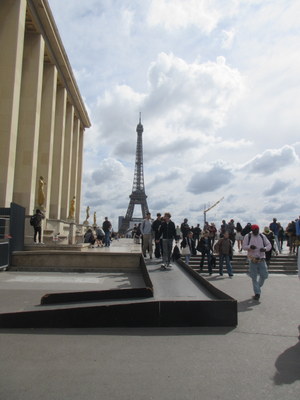
Afterward, on our way across the place to the museum, I got this shot of the Eiffel tower. The Place du Trocadero is directly across the Seine from the tower, so views of it line up nicely between the Trocadero's two mirror-image museum buildings.
At the museum, the folding seats turned out to be the old heavy ones again, and I had to leave my driver's license to borrow them. I can't imagine that anyone steals them—you have to pass through a couple of layers of staff scrutiny to get in or out of the building—but I guess it ensures that you bring them back to the desk when you're done rather than abandoning them in some random exhibit room.
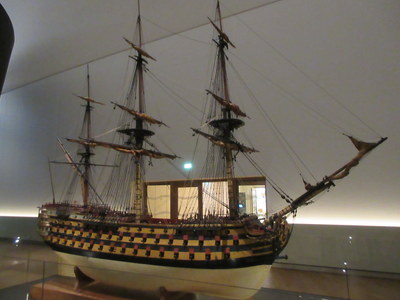
 The museum was just as fascinating as last time, and this time we covered (but by no means exhausted) all of it. Here at the left is a better photo than I got last year of this magnificent model of a three-masted, three gun-decked sailing vessel. It's only one of a vast collection of amazing models from two inches to twenty feet long.
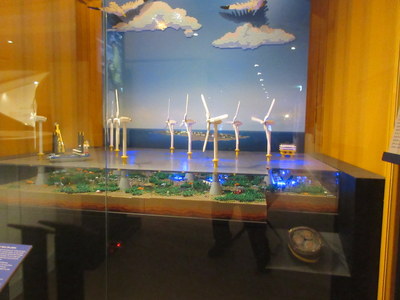
At the right is a model (made of Legos!) of a field of marine windmills.
I tried not to duplicate too many of last year's photos, so to see more, click on the link given above to last year's page.
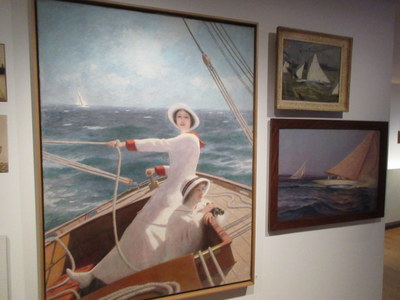
 At the left here is a painting of pioneering yachtswoman Virginie Hériot (1890–1932) in her boat the Ailée (the "Winged"), one of 16 she owned. In 1928, she won both the Coupe de France and a gold medal at the Amsterdam Olympics.
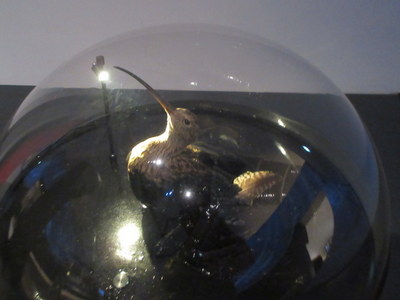
At the right is a stuffed bird under a glass dome. It said "snipe" to me, and Google images agreed that it was a woodcock or snipe, but on second glance, I see that it doesn't have that straight slope from forehead to beak that woodcocks have, and Google rightly described both the woodcock and the snipe as having straight beaks. So maybe it's a long-billed curlew? Any readers out there know for sure?
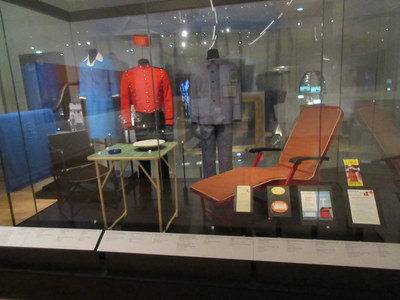
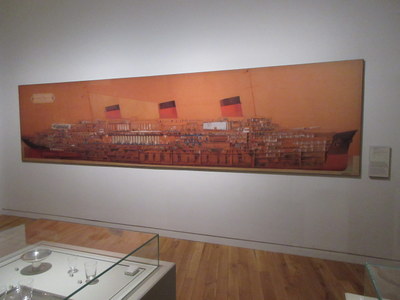 Upstairs, in a relatively small mezzanine area, are presented exhibits on the trans-Atlantic ocean liner trade. The case shown at the left displays items to be found aboard the France—stewards' uniforms, deck chairs, folding tables and chairs, dishes, wall art, towels, menus, luggage tags, ash trays, and travel brochures.
At the right, not a very good photo of an illustration of a cutaway view of the ship.
Definitely a worthwhile museum, as would be any of its many other branches scattered around France.
 For dinner, we went back to David Toutain for at least the third, maybe the fourth, time. I almost got a good shot of Notre Dame as we passed by on the way, but first some trees and then the taxi's window frame jumped in front just at the wrong time.
Our itinerary for this day is a good illustration of why we should find a hotel farther west. Both the restaurant and the museum are in the neighborhood of the Eiffel Tower, but our hotel is way across town at Bastille. So today we made that round trip twice—from hotel to museum, then back to the hotel to freshen up, then back to the restaurant, and finally all the way back to the hotel again. So many museums and good restaurants are clustered on the western side of things that we really should base ourselves over there to save travel time and expense.
 David Toutain just loves playing around with food and coming up with unexpected but delicious combinations. And I think he feels constrained by the concept of "courses." The tasting menu was nominally four amuse-bouches and nine courses, but if he happens to have come up with something especially good that day, he just adds it in, and many of the "courses" consist of three or four different dishes. It's a "surprise" menu, so there's no printed version of what you're given. And they often serve a different bread with every course. I take notes for all I'm worth, but when a dish consists of eight components, I've often forgotten numbers 2 and 3 before the waiter finishes reciting them all. He always tells me "no need to take notes, madame; we'll give you a list at the end," and I fell for that once, but no more. What they give you at the end is the list of things the chef wanted to remember to feature that night. It's not necessarily in the order you were presented with them, it doesn't necessarily list everything you were served, and it omits all the detail of accompaniments, sauces, and garnishes. Aaargh!
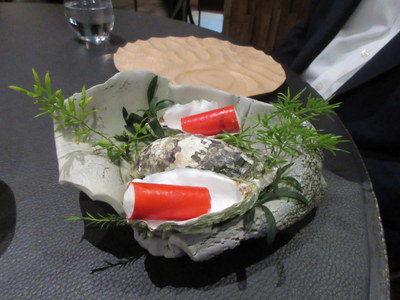
Nevertheless, he meal was another wow! The first amuse-bouche, at the right here, was oysters in creamy mixture in a cyindrical shell of raspberry-flavored sugar. Each of us got just one, a single bite's worth. We've had it here before, and it's still one of the best things we've ever eaten. Wow, indeed.
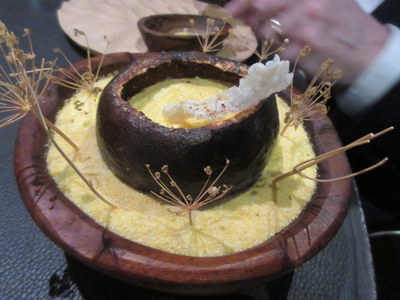
Next came a foamy cream of something in a brown bowl. Maybe polenta? It came with a crispy piece of something white to be dipped into a little bowl of cream of corn (shown below). The brown bowl rested in an outer bowl filled with dry, uncooked polenta studded with dried weeds (clearly in the family of carraway, dill, etc.).
My notes say "a very foamy drink made with tomato water, verjus, and something," but I don't remember it and don't seem to have a photo.
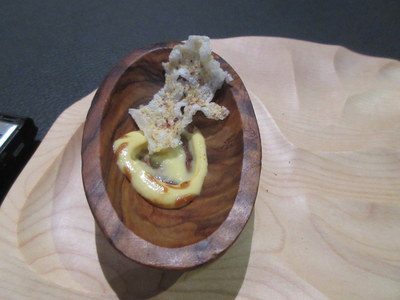
 Here's the cream of corn with the crisp for dipping.
[At this point I overhead the waiter telling another table something about mushrooms and a coffee infusion, but maybe they were having another menu?]
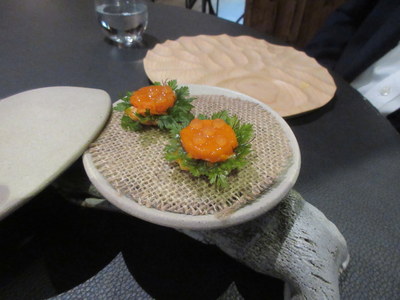
At the right, tartlets of carrot with "berce," (cow parsley, Anthriscus sylvestris, another plant in the family of those dried weeds).
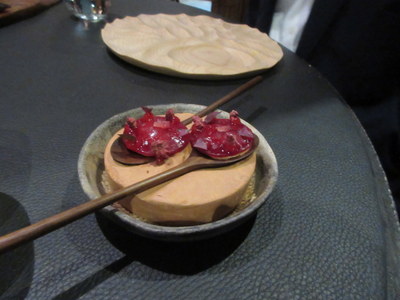 Next up, "ravioles" of roasted beet, each with one flake of a special kind of pepper on top and a little piece of petrified amberjack that we weren't sure what to do with.
They brought out for display the clay coffin in which beets are baked to reduce them and make them sweet. Each raviole was resting on a very thin crispy (perhaps rice) cracker and was yummy. Inside was more beet and bits of amberjack. I think the waiter said that the beet raviole was the last amuse-bouche.
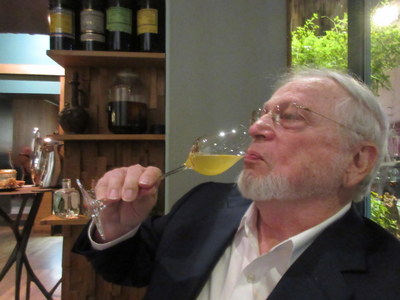
 The first official course was, of all things, a beer flavored with celery and mint, described as being made locally here in Paris by folks who know the restaurant. It was served in a wine glass. David gamely tried it; I didn't.
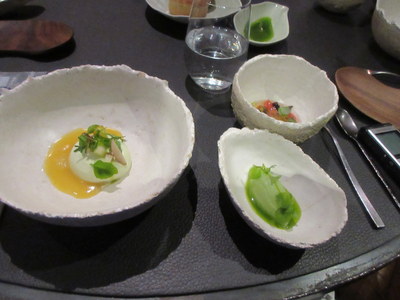
The beer was accompanied by three side dishes, shown at the right here, clockwise from 9 o'clock: a mousse of pea with bits of green bean standing up in it, tiny batons of peach on top, and a vinaigrette spooned around it; a little tomato salad into which the waiter poured something liquid; and a bright green tomato sorbet garnished with chickweed.
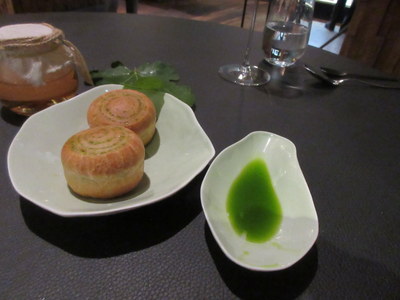
 At this point the first bread service arrived. And lest we forget what it was flavored with (and I would have), it's garnished with a large prominent fig leaf. The bread was more like pastry—flaky croissant-like dough coiled with a fig-leaf preparation and sided by fig-leaf-infused oil for dipping.
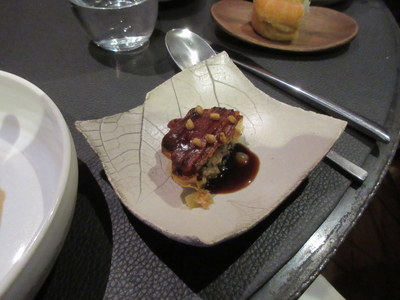
Next up, served with a white Jura, was a tartlet of cêpe (aka porcini, aka boletus) mushrooms with quail and barley. At least some of the barley took the form of little popped grains studded over the top surface.
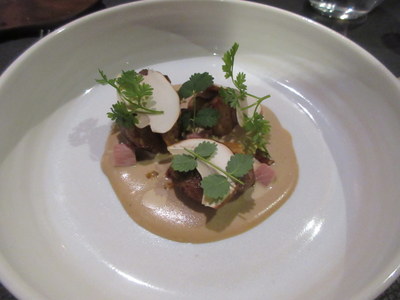
 Then came more cê7;pes, this time whole confit specimens, each topped with a very thin slice of raw cê7;pe, garnished with salad burnet and chervil, and resting on a creamy puree of cê7;pes. Between the confit mushrooms and the raw slices were little crispy crackers that turned out to be crispy (and tasty) sheets of quail skin. I think maybe the tartlet and the confit mushrooms were supposed to be considered a single course (#2?).
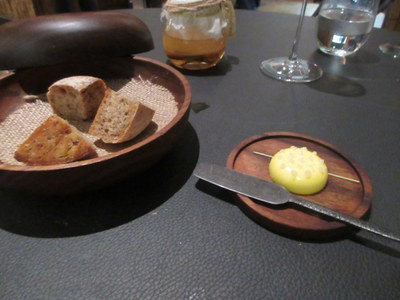
With the cêpes came a soda bread, with rye and spelt, accompanied by a special sweet butter studded neatly all over the top with little clear crystals. Salt maybe? And the butter dish was garnished with exactly one sprig of wild hay.
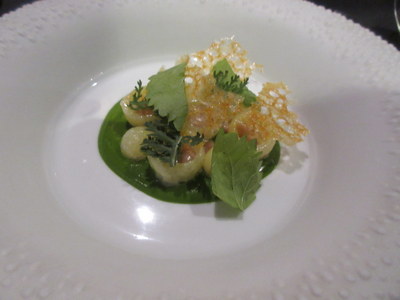
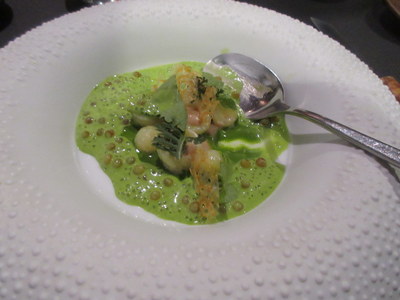 David said the third course was served with a particularly good Chablis. The waiter described it as potatoes worked with bananas, then sauced with a mixture of trout eggs, cream, and parsley.
These photos show it before and after the waiter poured the sauce on at the table. The little spheres in the sauce are the trout eggs.
I should have asked about the garnish. Some of it is clearly salad burnet, but the dark-green stuff I'm not sure about. It seems too dark green to be chervil . . .
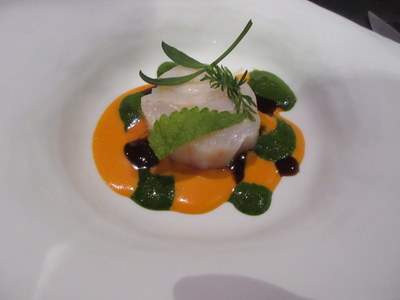
 The fish course was very delicately poached cod on a mild red pepper sauce.
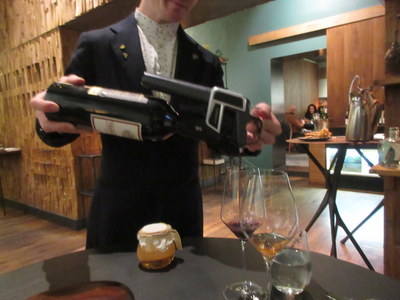
David was also very taken with the German riesling served with it, which was poured from a very large bottle (at least a magnum) topped with an amazing dispensing apparatus!
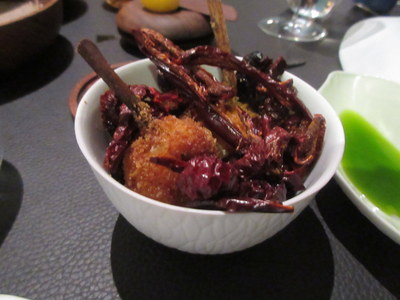
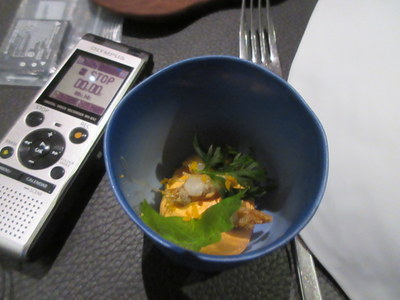 It came with a bowl of dried piquillo peppers in which rested two crayfish beignets, which we dipped, as directed, into a deep, blue dish holding a little sauce made from the heads of the crayfish.
As shown in the right-hand photo, I was documenting diligently—you can see both my pocket recorder, freshly shifted to a new, empty channel, and the spare battery I'm about to put in my camera.
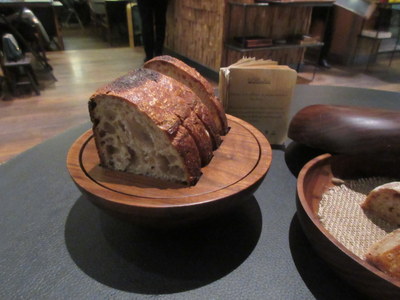
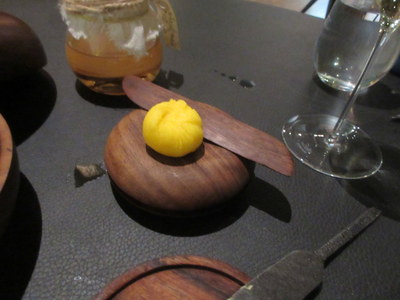 Then more bread. They never took the old breads away, so we had quite a collection by the end of the meal.
And more special butter, this version very dark yellow and not garnished with anything (except the avante-garde wooden butter knife).
Written 3 February 2026
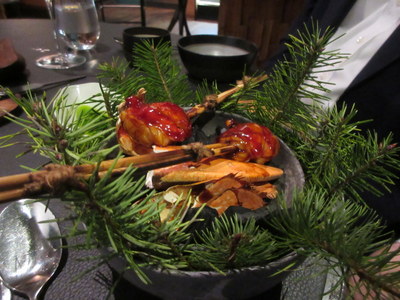
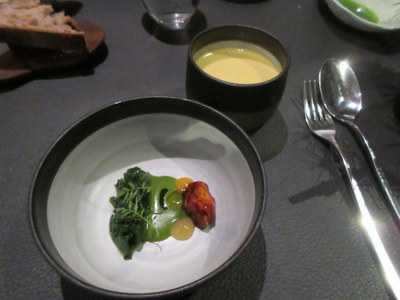 The bizarre objects at the left here are barbecue lobster lollipops, chunks of the lobster tail, each impaled on a cluster of skewers bound together with some sort of vegetable fiber. They are resting on a bed of Douglas fir twigs, as something always is in every menu by this chef. I know he commutes home to Normandie every weekend to harvest from his garden, and he must have a Douglas fir in his yard.
The tender meat of a whole claw, for each of us, was served on a little plate on the side, accompanied by multicolored vegetable- and fruit-based sauces. In the photo, you can also see the pot of yellow sabayon sauce the lollipops were to be dipped in.
At the table, the waiter drizzled lobster oil over the claw from the claw's shell; they nipped the pointed end off so that the shell could be used as a small pitcher.
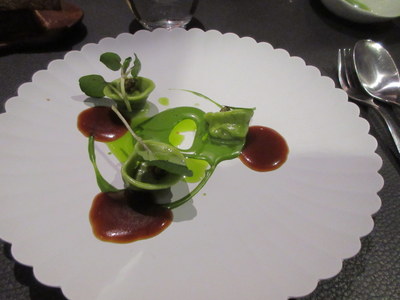
 Next up was this plate of watercress (colored, filled, and sauced) tortellini accompanied by a dark brown sauce that the waiter insisted was made only with celery.
At the table, the whole dish was sprinkled over with oil of something off the stems of a bundle of watercress.
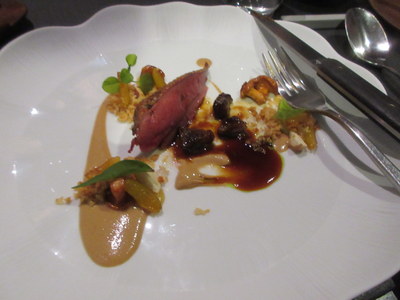
The meat course was roasted breast of pigeon, accompanied by a wine from St. Emilion (Bordeaux). It was served with cauliflower florets and small chanterelle mushrooms in a foamy sauce. The creamy yellow was made of from mirabelles, little yellow plums.
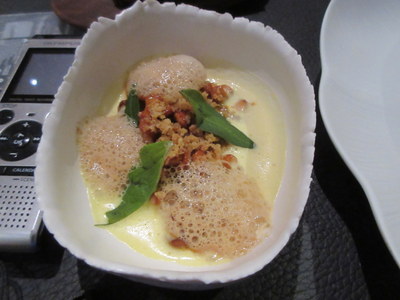
 With the meat course, we each got a side dish of more chanterelles, this time chopped up
and we each got half the brest, then there's a side dish of more chopped up chanterelles with more of the foamy sauce and with chopped fresh raw hazelnuts sprinkled over.
With the meat course, we each got a side dish of more chanterelles, this time chopped up
and we each got half the brest, then there's a side dish of more chopped up chanterelles with more of the foamy sauce and with chopped fresh raw hazelnuts sprinkled over.
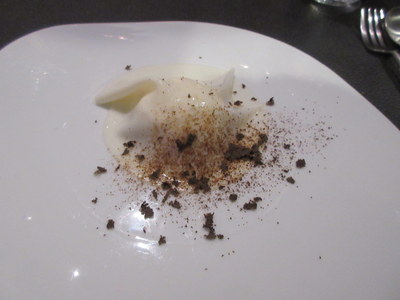
The first dessert consisted of a very thin and crispy cookie, gingerbread maybe, with a heart of caramel on top of it, and on top of that a "milk veil" and some chocolate chips. The veil was a thin sheet of milk gelled with agar draped over the rest. It was billed as a play on vanilla and served with an "ice cider" (a cider enriched by having some of the water frozen out of it, analogous to an ice wine).
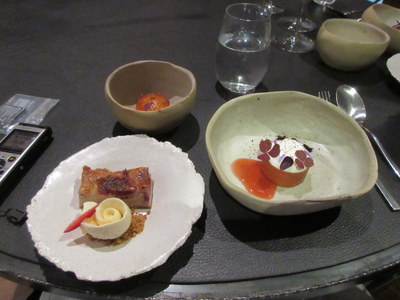
 The second dessert featured a frozen confit plum on another of those crispy cookies, a rectangular slice of a prune or plum clafouti based on vanilla custard, a curl of rye-flavored ice cream accented by a thin slice of fresh plum, and a cylindrical cookie shell filled with a brebis (sheep's cheese) mousse and topped with reddish clover leaves and a couple kinds of purple flower petals.
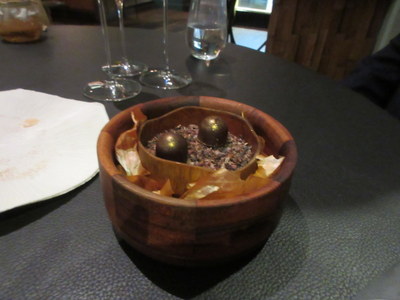
My notes say the mignardises included were meringues with cassis jelly, but I don't seem to have gotten a photo of them. The iridescent chocolates (resting on a bed of cocoa nibs, I think) will filled with something unusal, but I don't remember what.
Previous entry
List of Entries
Next entry