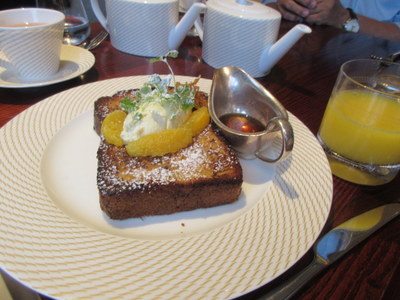
 Breakfast was in Gordon Ramsey's River Restaurant at the Savoy. At the left, a neighbor's French toast with butter, syrup, orange segments, sprigs of mint, and a shower of powdered sugar.
Thursday, 18 September 2025, London, Westminster Abbey and Back to the Future
Written 5 January 2026
Breakfast was in Gordon Ramsey's River Restaurant at the Savoy. At the left, a neighbor's French toast with butter, syrup, orange segments, sprigs of mint, and a shower of powdered sugar.
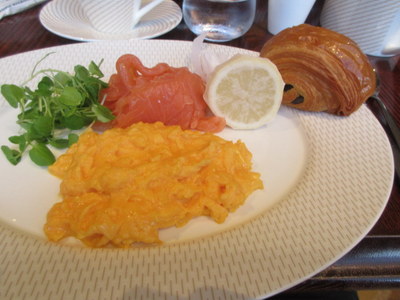
At the right, the outstanding scrambled eggs with smoked salmon (pain au chocolat on the side) that David and I both chose and that was so good that we had it on all subsequent mornings in the hotel. The microgreens might have been cress or mâche.
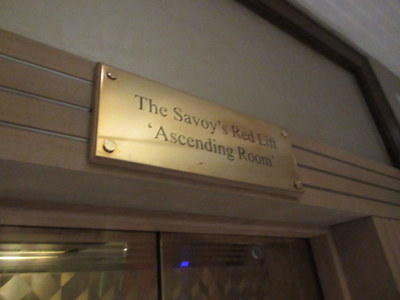
 Here's the little brass plaque marking the hotel's historic "red lift" (I think a green lift serves a different wing), originally called the "rising room."
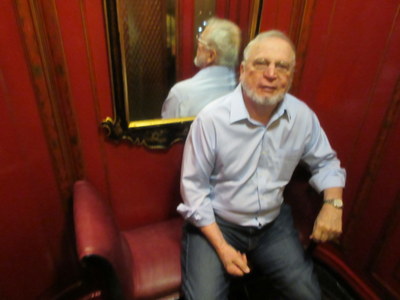
And here is David, ensconced within it. Strangely, that red leather bench disappeared and reappeared at seemingly random intervals in the course of the day.
 The excursion for the day was a guided tour with Fiona of Westminster Abbey. Mick picked us up at the Savoy for the last time and, on the way to Westminster, took us on a panoramic tour of central London while Fiona pointed out all the landmarks.
Written 19 January 2026
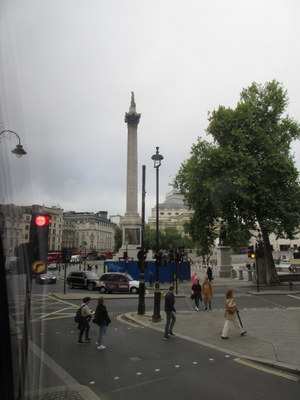
Following the Strand, right from the hotel's front door, led directly to Trafalgar Square, marked by Nelson's towering column in the center (at the left here). This is where the National Gallery and the National Portrait Gallery are located, about half a mile from the hotel.
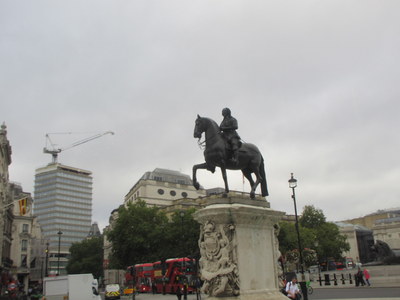
At the right, on a somewhat shorter pedestal, is Charles I.
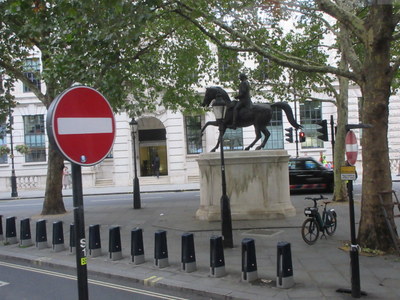
 Down lower still is George III.
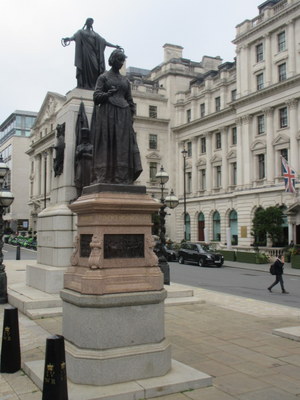
A block or two beyond Trafalgar, in Waterloo Place, is the Crimean War Memorial; at the right here is the statue of Florence Nightingale (the "Lady with the Lamp") that forms part of it.
These are only a few of the statues that litter the ground in this part of the city.
Written 26 January 2026
We then followed a winding route that hit all the famous locations and iconic names: St. James Street, Jermyn St., Pall Mall, Picadilly Circus (with a statue of Eros on a pillar in the center) (we were assured that Princess Elizabeth and her sister Margaret actually came out with the crowd in Picadilly Circus on VE day but kept her hat pulled low so as not to be recognized).
We left Picadilly Circus on Regent Street, apparently London's grandest shopping street, filled with crescent-shaped buildings by John Nash. Fiona said "to the west of us is Mayfair, and to the right is Soho." Soho is full of creative industries like film. It was once the red-light districtmdash;I even saw someting called "Glass Street," but it turned out actually to have housed a glass works.
We paralleled Carnaby Street for a while—it was apparently the center of swinging London, Twiggy, and the Beatles. We passed Hamling's Toy Store—London's largest and oldest, six floors of toys and a dancing top hat out front, advertising it. We also saw Liberty's home furnishing (famous for their little paisley prints), Fortnum and Mason (classier than Harrods, according to Fiona), Saville Row (gentlemen's tailoring; apparently the last live beatles performance took place on a roof on Saville Row).
When we passed the Coach and Horses, a very old and very traditional pub, Fiona pointed out that the bountiful flowers decorating its façade were real, not like the fake ones so many establishments use these days. Nearby, on Bruton St., is the London house of the Earl and Countess of Strathmore, maternal grandparents of Queen Elizabeth II. Elizabeth was born there.
At some point along in here, Fiona explained that a "terraced street" is one on which all the houses are joined together—what we might call "row houses" or even "condominiums"; I had always wondered about that, since a "terraced street" sounds to me like one that descends a hill on several levels . . .
We turned left at Berkeley Square (where the nightingale of song is supposed to have sung), which has some of the oldest plane trees in London, some planted around the 1760's. Annabel's, an exclusive members nightclub in Berkeley, does fantastic decorations on the front of their building. They're were decorated for Halloween when we drove by.
We turned left on Mount St., and Fiona pointed out a few terra cotta buildings, which she said were very fashionable at one time. One now houses a pizza place. Just around the corner from Mount St., near Grosvenor Square, we passed the famous Connaught Hotel. It was originally the Prince of Saxe-Coburg Hotel, but in 1917, they found a suitable British prince to name it after instead. Grosvenor Square was all torn up for construction. Fiona said there were statues of FDR, Ronald Reagan, and Eisenhower somewhere in there, as well as a 911 memorial, but I didn't spot them. The name Grosvenor comes from the French "gros veneur," great hunter.
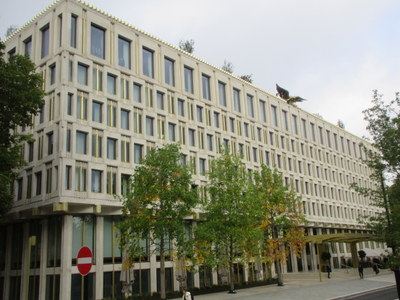
 This building on Grosvenor Square with a giant gilded alumninum eagle on the roof used to be the American embassy. It's now the Chancery Rosewood Hotel, but it's a listed building designed by a famous architect, so they can't take the eagle down. The eara nearby is called Little America.
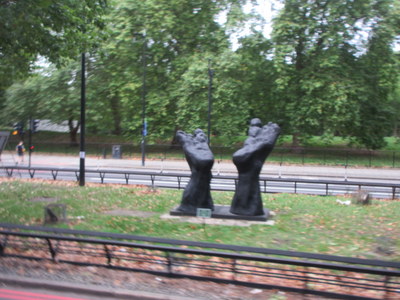
At the right is a sculpture on Park Lane named Visitor V. According to Wikipedia, it was installed in 2020–21 and "represents a giant, otherworldly figure 'crash-landed' into the city, symbolizing the concept of the outsider." The Grosvenors still own Mayfair; The Duke of Westminster is current head of the Grosvenor family. They used to live right here at the intersection of the square with Park Lane; the house is now the Grosvenor House Hotel. Queen Elizabeth learned to ice skate in the Grosvenor Hotel, where the ballroom used to be an ice rink.
Along Park Lane and Hyde Park, we passed a lot of automobile show rooms. Hyde Park segues into Kensington Gardens to the west, and at their far end is Kensington Palace, where Prince William ad his family live.
At the end of Park Lane, just where a corner of Green Park/Buckingham Palace Gardens almost touches a corner of Hyde Park, sits cramel-colored Apsley House, London home of the first Duke of Wellington. The current duke (the 8th) still livs on the top floor; the rest is now a museum and open to the public. The Duke liked gadgets, so he had the first central heating in London and a long gallery with shutters mirrored on the inside. Onr source I read said it was modeled on the hall of mirrors at Versailles; another said it was a practice in cities where houses were cut off from the sun by other buildings (the mirrors could be angled to reflect additional light into the room).
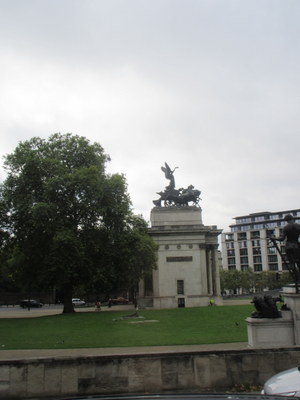
 Across the street is the Wellington Arch, shown here in side view, which is topped by a statue of Winged Victory on a quadriga, a chariot pulled by four horses harnessed abreast. It's entitled "Peace Descending on the Quadriga of War" and is one of the largest bronze sculptures in Europe.
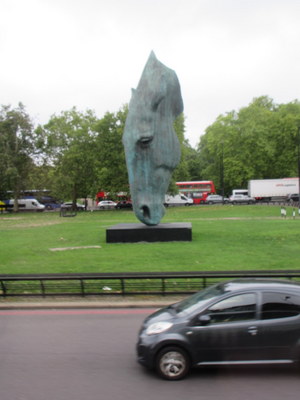
Also in Hyde Park, we passed "Still Water," a huge (10-meter) bronze the sculpture of the head of a horse, drinking (inspired by the Elgin marbles). It's one of London's largest free-standing bronze sculptures.
Soon we were driving along a wall topped with barbed wire, which Fiona assured us was the wall of Buckingham Palace gardens (the largest private garden in London, of course). By some sort of special permit, we were allowed to drive all the way around the palace, where the union flag flies when the monarch is in London.
Through the Mall, all the way to Admiralty Arch, the flagpoles were flying alternate American and British flags because of Trump's visit. Normally, the formal changing of the guard is done on Monday, Wednesday, and Friday, but they're doing a special one today for Trump's benefit. Our group will visit the one tomorrow.
Fiona pointed out the guards who were about to go on duty and those about to go off. According to the schedule, it should have been the irish guards going on duty, but it clearly (to Fiona) wasn't, so she isn't sure who they were. In front of the guards' museum is a statue of a giant corgy. During WWII, a bomb fell on the guards' chapel during services and was among the worst of the war for fatalities. In Churchill's subterranean war rooms, a map indicates with dots all the bomb drops that they could feel inside the war rooms, and the guards' chapel was one of them.
At the end of WWII, Fiona said, the last man out of the war rooms turned out the lights and closed the door, and tyey sat there unchanged until the 1970's. Today, they're open for tours, and David and I toured them on a previous trip.
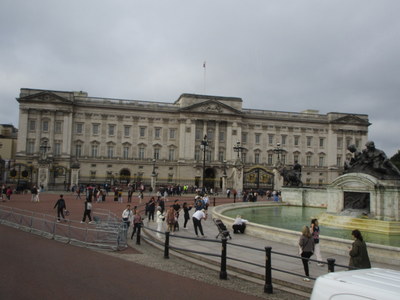
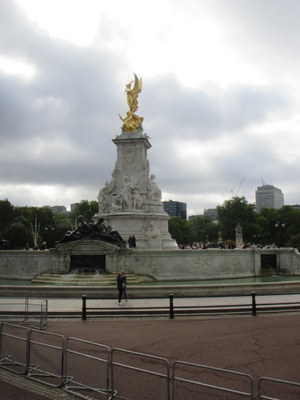 At the left here is the façade of Buckingham Palace. According to Fiona, George IV built the place into what it is today.
At the lower right in the photo, you can see part of a round pool and the edge of a pedestal. The right-hand photo shows the what stands on that pedistal—the Victoria Memorial, another winged victory, this one blindingly gilded.
As we drove past Big Ben, Fiona told us that its face was cleaned and repainted between 2017 and 2020. The numbers had originally been blue but were painted over with black at some point. The modern restoration restored the original Victorian blue color.
She also told us that the last time Big Ben was out of synch was in August of 1949, when a large flock of starlings landed on the minute hand and were so heavy they slowed the clock by 5 minutes! The keeper had to run up the stairs and lean out with a broom to pull it back into place.
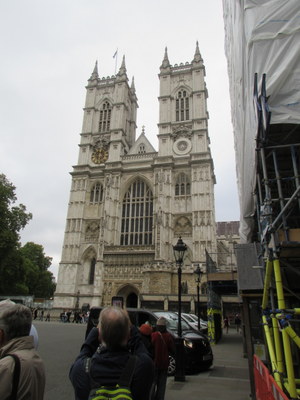
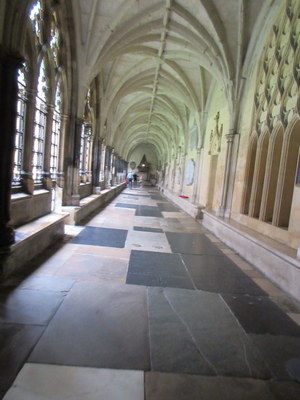
Once we got to Westminster Abbey, we all piled out, tuned up our Vox devices, and followed Fiona in through a side entrance, past the long queue at the main one. Even Tauck couldn't arrange a private tour of the abbey, so lots of other groups and individuals were there as well.
But initially, we entered through the cloister, which was deserted and serene.
Written 27 January 2026
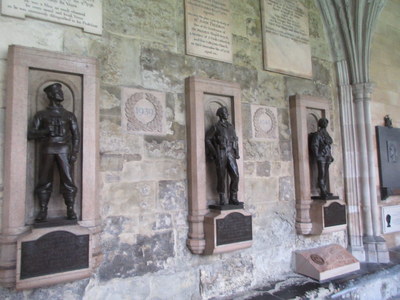
 In the cloister is the 1948 Combined Services Memorial. The three bronze figures represent the Royal Navy Submarine Service, the Commandos, and Airborne forces.
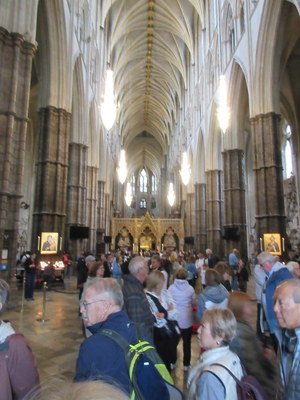
In the right-hand photo, you can see the difference between the empty cloister and the much busier nave.
Policy has changed since our last visit—photography (but not videography) is now allowed inside, so I was able to get some great shots. Fiona talked about the history and architecture in the many sections of the building, but we also spent a lot of time grave-spotting. Actually, only some of the plaques set in the walls and floor actual mark graves; many are simply memorials to people buried elsewhere. Still, about 3200 people are buried in the church.
The abbey was founded in the 11th century, under Edward the Confessor, and the original church was consecrated in 1065, before the Norman conquest. Then, in the 13th century, Henry III tore most of it down and rebuilt it larger (providing more space for coronations and royal burials) in the Gothic style with buttresses. Richard II built the final portion, the nave. Fiona told us that Richard was crowned at age 9, was the first monarch to sit for a portrait during his reign and lifetime. He also introduced the handkerchief to London; his clothing bill was huge, and he wasn't a terrific king.
Westminster Abbey was a monastery for 500 years. It has always been associated with a school, which is still in business today. It's described as a "public school," but that doesn't mean the same thing as in the U.S. It's what we would call a coed private boarding and day school with very high standards. It stopped being a monastery when Henry VIII threw the monks out.
Charles and Diana were married at St. Pauls, not in Westminter Abbey.
The coronation chair is pretty battered; the red velvet was recently added for the coronation of King Charles III. It has space underneath for the Stone of Scone. Edward I (Longshanks) brought the stone back from Scotland, and originally, English kings sat sat directly on it to be crowned. william and Mary may have shared the throne, but William sat in the chair; Mary sat somewhere else. More recently, the stone has been returned to Scotland, but they lend it back for coronations.
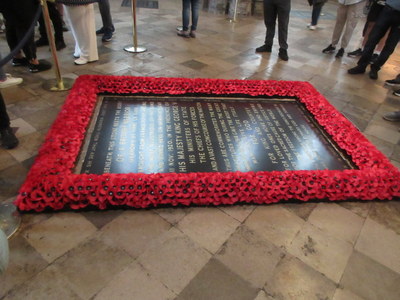
 We were told it was fine to walk on the graves and markers (and a good thing, too, as otherwise, it would have been a very difficult game of hopscotch, as they are thick on the ground). Winston Churchill has a very large memorial plaque in the floor but is actually buried near Blenheim Palace. He is supposed to have said that he never let people walk all over him in life and saw no reason to start in death. The only grave that is never walked on is that the of unknown soldier, fenced off with red crêpe-paper poppies, shown here. It is marked with Belgian marble and holds an English coffin buried in French soil.
The medal of honor was also awarded to the unknown soldier, and for some reason a tradition has arisen in which new bridges come to place their wedding bouquetson this grave.
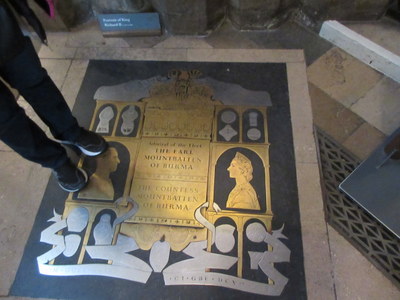
Nearby is the marker for the Earl and Countess Mountbatten of Burma.
Written 28 January 2026
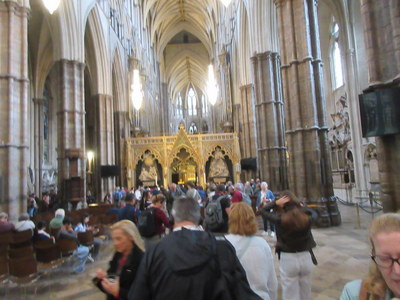
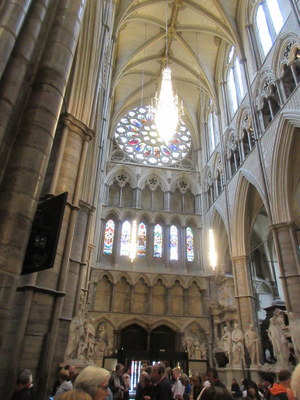 The gilded rood screen is high Victorian Gothic. You can see the pipes of the organ, mounted above it on the walls to either side.
Fiona assured us that the glass in the rose window at the right is original, but the stonework in which it's mounted was done separately, and the panels didn't fit back in properly. The saints' feet are cut off in several places.
The space is lit by 16 large Waterford crystal chandeliers, a 1965 gift from the Guinness family. The crystals were missing from two of them; they had been sent out for cleaning but will soon be put back in place.
The "normal" capacity of the church is 2000 people, but for Queen Elizabeth II's coronation (or funeral, I'm not sure which), they wedged in 8000 by installing extra seats and heavy machinery.
Part of the apse was destroyed by a bomb during WWII and had to be reconstructed in the 1950's from memories and photos.
David Hockney made a modern stained glass window (the only true stained glass in the place); he wanted to make one for the queen during his lifetime. I portrays a British landscape, with many (rather abstract) trees. According to Fiona, The dean really liked it; the queen was polite. Fiona also pointed out an Italian mosaic from the thirteenth century; apparently, if if you can decipher the swirls, it tells you the date of the end of the world.
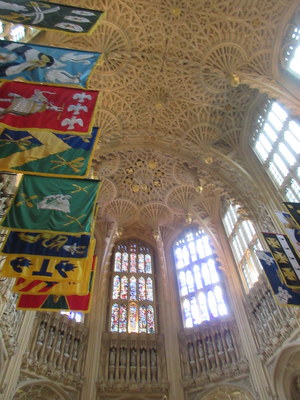
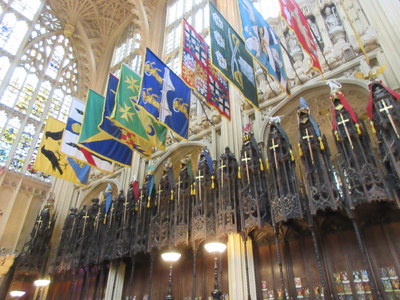 The 15th century Lady Chapel, built by Henry VII, is the home (and the chapel) of the Order of the Bath. Members of the order are assigned a choir stall each; that's why new members are said to be "installed." They get to put up a banner, bearing their arms, among those you can see displayed here. When members die, the banners go, but they keep a miniature of each one on the back wall of the corresponding member's stall. You can see a few of them at bottom edge of the right-hand photo. Each new member can therefore see who has held his or her stall in the past.
Henry VII married Elizabeth of York, who was the sister of the princes in the tower, ending the War of the Roses by uniting their two houses. Both of them are buried in this chapel. Henry VIII is buried at Windsor, with Jane Seymour, his favorite wife.
Note the chapel's magnificent ceiling. The abbey has another ceiling like this, and there are only two more in existence anywhere.
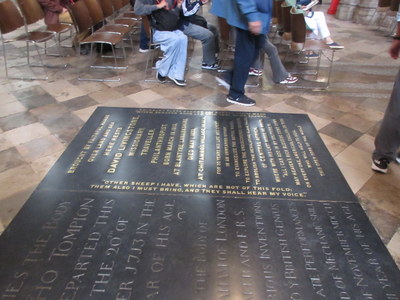
 And then, of course, there were the graves and memorials. I tried to resist taking photos of all of them (hundreds!), and I'll display only a few of those I did take here. At the right here is, in the foreground, that of Thomas Tompion (1639–1713), the greatest clockmaker of all time. He made a clock that was sent by ship from England to the Jamaica and back by sailing ship and lost only 2 minutes during the journey. That kind of precision is what finally allowed navigators to determine longitude accurately.
Just beyond it is the marker for Dr. Livinstone (of ". . . I presume.")
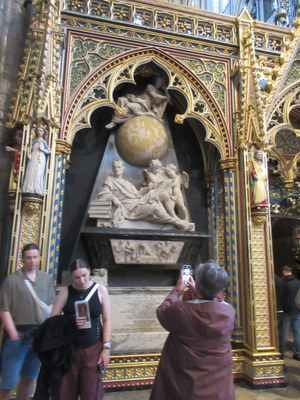
At the right is Newton, lounging in a toga atop a sarcophagus and beneath a celestial globe. I had not realized that, in addition to all his scientific accomplishments, he was also Master of the Royal Mint for decades!
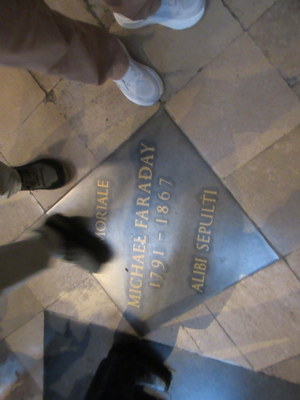
 At the left here is the memorial for Michael Faraday, inscribed at the bottom "Alibi sepulti." I learned just yesterday, during Team Trivia, that "alibi" means "elsewhere," so the inscription must say "entombed elsewhere."
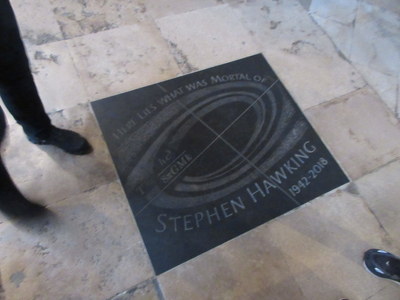
The marker at the right reads "Here lies what was mortal of Steven Hawking," so I assume he's actually buried here.
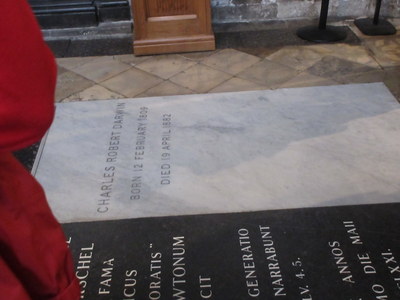
 At the left here is Charles Darwin, which I regretted not being able to photograph when we were last here.
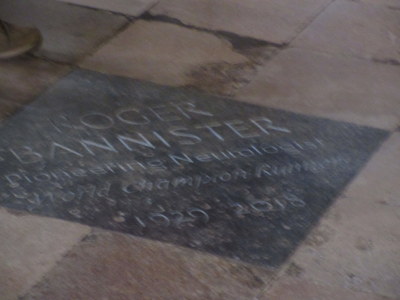
At at the right, Roger Bannister, "Pioneering Neurobiologist."
The list goes on and on. Beyond Newton is Kelvin (the one who said that if he'd seen farther than others it was because he stood on the shoulders of giants—just about the best statement ever of how progress in science works).
In one transcept were politicians, like Peele, Gladstone, and Disraeli. Overwrought stone lions weep inconsolably at the foot of the tomb of General Wolfe, who fought for and kept Canada for the Brits).
In "Poet's Corner" were Browning and Tennyson, who are are actually buried there. The rest are commemorative plaques. Those I happened to capture legibly in my photos include Lord Byron, Dylan Thomas, George Eliot, Gerard Manly Thomas, Henry James, Lewis Carroll, Alfred Lord Tennyson, T. S. Elliot, Edward Lear, D. H. Lawrence, Keats, Rudyard Kipling, Shelly, and a list of 16 names on one plaque that I can only assume, from the names I recognize (Rupert Brooke, Wilfred Owen, Siegfried Sassoon) were poets killed in WWI.
Charles Dickens didn't want to be here and didn't want statues or anything, but Queen Victoria put in a plaque anyway, with a quiet funeral.
Others I saw, or that Fiona pointed out were:
The oldest effigy is a well-worn gisant of Gilbert Crispin, Abbot 1085–1117, now in a sheltered spot in the cloister.
And paintings found on the wall behind a memorial that was taken down for cleaning were 100 years old when Chaucer saw them.
An Amazing place altogether.
When our tour of the abbey ended, some of our party then peeled off to visit other nearby sights, like Churchill's war rooms, but we'd already done that on a previous visit, so we reboarded the bus (sorry, the coach), and Mick ferried us back to the hotel before saying farewell and heading back to Scotland to pick up the next Tauck group.
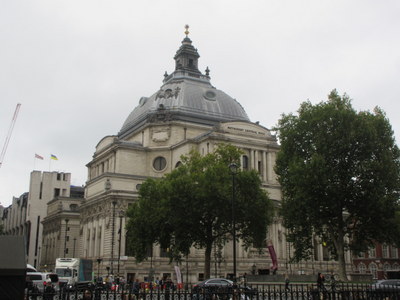
 On the way back to the Savoy, I caught this good shot of Methodist Central Hall, pretty much accross the street from the abbey. It functions as a working Methodist church but also as a large conference center. The United Nations held its inaugural assembly there in 1946.
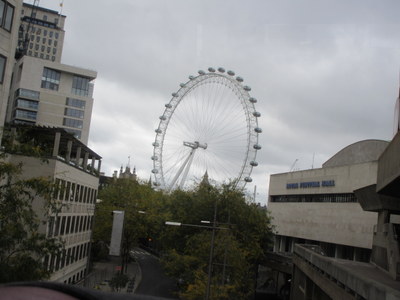
Then the London Eye posed obligingly. That's the Royal Festival Hall to the right of itand, I'm pretty sure, Big Ben and the Houses of Parliament down in the shrubbery.
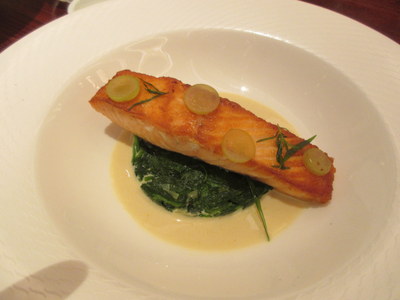
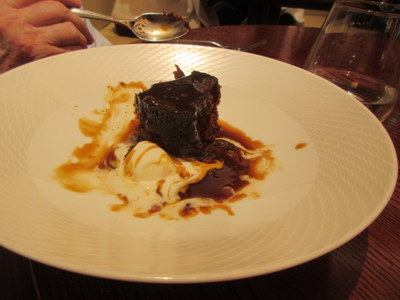 We had lunch at the River restaurant in the Savoy: Lovely salmon on spinach and sticky toffee pudding.
Then we took it easy until time to rendezvous for our pretheater dinner (also at the River) with the rest of the group.
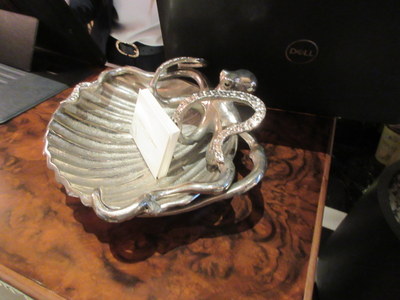
 At the left here is a particularly attractive little silver dish, portraying a scallop shell and an octopus, that sits on the hostess stand at the River Restaurant, holding business cards.
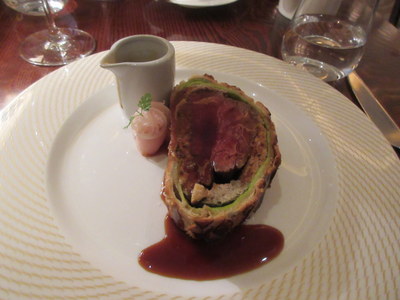
And at the right, Gordon Ramsay's famous beef Wellington! The pitcher contained rich beef gravy, and the small pink object was a lightly pickled shallot. I think the set menu offered a nonbeef alternative, but everyone within camera range ordered the beef.
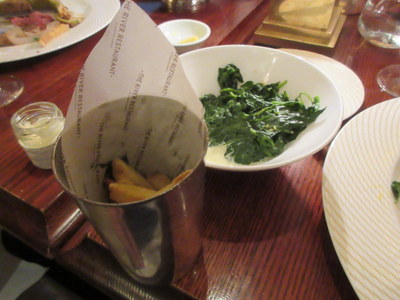
 On the side, we got spinach and a cone-shaped container of fries. When I asked for mayo for the fries, they brought me the tiny, individual jar you can see to the left of the cone.
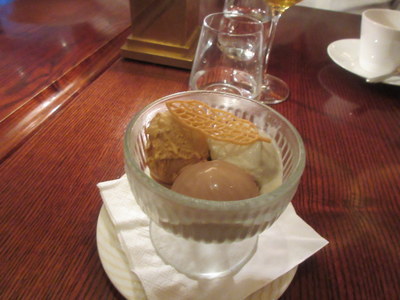
For dessert, I chose the ice cream assortment, topped with a tiny pastry leaf.
 Not only were both dinner and the play on Tauck, but Stefano even gave each couple cash to pay for a taxi, whether it was needed or not! Because our theater, the Adelphi, was only a two-minute walk away, we just strolled over there for Back to the Future and used the taxi money to buy the large and elaborate souvenir program. (Though I couldn't actually use the cash Stefano gave us—the entire establishment was cashless, so you could only buy a program on a credit card.)
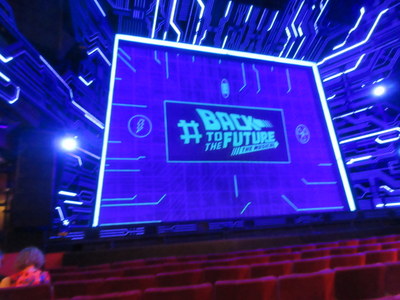
We were there in plenty of time, so we got to watch the whole cycle of light effects on the curtain through several times. At the left is the basic projection. At frequent intervals, the zigzag lines of lights around the central rectangle ran along their tracks, in and out of sight, and were replaced by others doing the same thing.
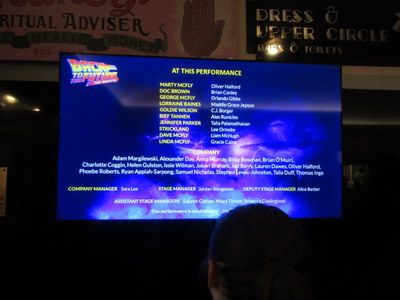
Periodically, the screen at the right would pop up, reminding us of the evening's cast. We got the understudy rather than the regular lead. In between, other little rectangles would pop up, looking like old-fashioned, MS-DOS messages and saying things like "Please switch off your smart phones when the show starts. They weren't invented in 1985. Proceed (y/n)?" and "No photography during the show. It might interrupt the space-time continuum." and "But it is okay to photograph this and tag with #BACKTOTHEFUTURE. Proceed (y/n)."
The show was great. I especially liked the song entitled, "Hello? Is Anybody Home?" At the end, where, in the movie, the Delorean lifts off and flies away, the Delorean on stage, with Marty and Doc in it, zoomed out over the audience and did a full barrel roll before returning to the stage and zooming off into the background. Fun! Previous entry List of Entries Next entry