Recommended Reading
Graduate school involves learning much more than the content of a
particular discipline. The books, essays, and papers collected here
offer useful perspectives on scientific reasoning, learning,
conducting research, ecology and evolution, and academic life.
Recommendations are not intended as required reading or endorsements
of every argument presented, but as starting points for reflection
and discussion.
Doing Science
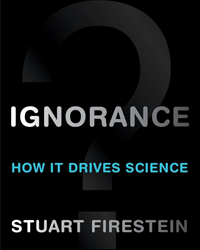
Ignorance: How It Drives Science
Stuart Firestein
Science is often presented as an accumulation of established
knowledge, while research is fundamentally concerned with what
remains unknown. Firestein offers an accessible discussion of
how scientists identify productive questions, work with
uncertainty, and use the limits of current knowledge to guide
new research.
Recommended by: Austin Mast (faculty)
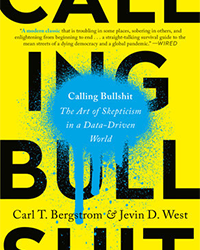
Calling Bullshit: The Art of Skepticism in a Data-Driven World
Carl T. Bergstrom and Jevin D. West
Researchers routinely encounter quantitative claims presented
through statistics, figures, models, and data visualizations.
Bergstrom and West provide a practical introduction to
recognizing misleading uses of data and evaluating whether the
evidence presented actually supports a claim. The broader
lesson, interrogate evidence rather than being impressed by its
presentation, is especially valuable in scientific research.
Recommended by: Shelly Gaynor (faculty)
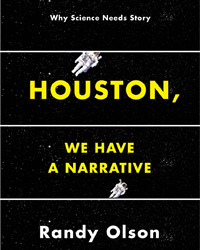
Houston, We Have a Narrative
Randy Olson
Scientists are trained to prioritize accuracy and completeness, but effective
communication also depends on structure. Olson argues that scientific ideas
are easier to understand and remember when they are organized as narratives
rather than presented as disconnected facts. The book is especially useful
for thinking about talks, papers, grant proposals, and other situations where
researchers must guide an audience through a scientific argument.
Recommended by: Laura Anthony (EERDG)
Thinking and Learning
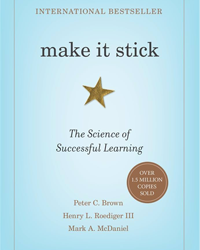
Make It Stick: The Science of Successful Learning
Peter C. Brown, Henry L. Roediger III, and Mark A. McDaniel
Graduate students must retain information from coursework,
scientific literature, teaching, and independent study.
Make It Stick discusses research on learning and
emphasizes strategies such as retrieval practice, spacing, and
interleaving. It is particularly useful for reconsidering
familiar but often inefficient study habits such as repeated
rereading.
Recommended by: Josh Rowe (EERDG)
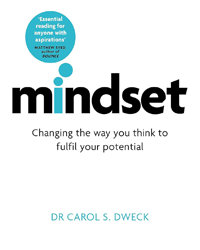
Mindset
Carol S. Dweck
Dweck's distinction between fixed and growth mindsets provides
a useful framework for thinking about how people respond to
difficulty, criticism, and failure. These experiences are
unavoidable in research, where experiments fail and skills
develop gradually. The growth-mindset framework is best
approached as a perspective for thinking about learning rather
than as a universal explanation of achievement.
Recommended by: Josh Rowe (EERDG)
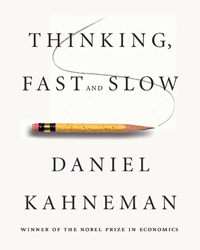
Thinking, Fast and Slow
Daniel Kahneman
Kahneman introduces a broad framework for thinking about
intuitive and deliberative judgment and explores heuristics,
biases, probability, and decision-making. These ideas provide
useful vocabulary for considering how scientists interpret
evidence and make decisions. Readers should be aware that some
findings discussed in the book have subsequently been
reevaluated as psychological research has confronted questions
of replication and reproducibility.
Recommended by: Josh Rowe (EERDG)
Ecology and Evolution
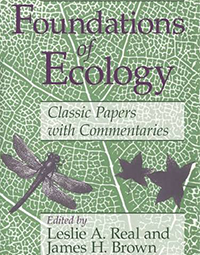
Foundations of Ecology
Edited by Leslie A. Real and James H. Brown
This collection brings together influential papers that helped
shape modern ecology. Reading foundational work in its original
form provides historical context that textbooks often cannot:
how important questions were originally framed, what evidence
was available at the time, and how concepts that now seem
familiar developed through scientific debate.
Recommended by: Tom Miller (faculty)
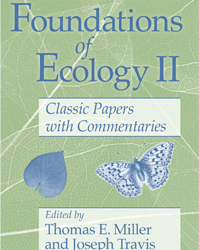
Foundations of Ecology II
Edited by Thomas E. Miller and Joseph Travis
Building on the historical perspective of Foundations of Ecology,
this collection brings together influential ecological literature from a more
recent period in the development of the field. Reading these papers in their
original context helps reveal how major ecological questions, methods, and
theoretical debates developed over time rather than appearing fully formed in
textbooks.
Recommended by: Tom Miller (faculty)
Where Is Natural History in Ecological, Evolutionary, and Behavioral Science?
Joseph Travis, 2020, The American Naturalist
Travis examines the changing role of natural history within ecology,
evolution, and behavioral science and argues for the continued importance of
careful observation and detailed knowledge of organisms. The paper is useful
for graduate students because it highlights the relationship between natural
history, hypothesis formation, and the broader development of scientific
questions.
Recommended by: Grace Soltis (EERDG)
Read the paper here
Academic Life
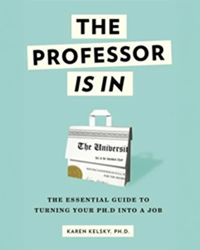
The Professor Is In
Karen Kelsky
This book provides a practical perspective on academic career
preparation, including CVs, job applications, interviews,
professional communication, and the structure of the academic
job market. Because hiring practices vary substantially among
disciplines and continue to change, its recommendations are
most useful when considered alongside current advice from
mentors and recent applicants in your field.
Recommended by: Carlie Ochoa (EERDG)
Suggest a Reading
This collection is intended to grow through recommendations from EERDG
members. If a book, essay, or paper has meaningfully influenced how you
approach research, teaching, graduate school, or scientific thinking,
consider recommending it for inclusion. Contact information for the
current EERDG cabinet is available on the About EERDG
page. Resource descriptions are currently supplied by AI overview. Recommenders are
invited to provide a brief synopsis of the suggested work.