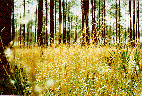
Field Guide to the Ground Cover
of the Apalachicola National Forest

My long-term interest in geographic variation in the size and shape of birds led to transplant experiments with red-winged blackbirds in the 1980's (James, 1983) and then to tests of the theoretical assumptions underlying selection models (James et al., 1991). A review article (James, 1991) summarizes my view that the similarities in patterns of geographic size variation among different species of birds are best explain ed by both genetically based and environmentally induced physiological adaptations to a combination of the temperature and moisture regimes of the environments of their respective populations. The article provides a statistical test of this idea for North American passerines. It does not bother me that the genetically based patterns are not apparent in the mitochondrial DNA of the blackbirds (Ball et al., 1988).
My interest in data analysis has led to a series of papers with statisticians, on whom I am totally dependent for statistical advice. The most recent exam ples are papers with Charles McCulloch like the review of multivariate analysis in ecology and systematics (James and McCulloch, 1990), a paper about the streng th of inferences about the causes of trends in bird populations (James and McCulloch, 1995), one with my former student David Wiedenfeld as an additional author (James et al., 1996), and a reply to a complaint (McCulloch et al., 1997). We have developed methods for the analysis of data from the Breeding Bird Survey. The results reveal patterns not identified by others, such as declines in several species of warblers in highland areas of the central and eastern United States in the last 25 years, even species that are stable or increasing elsewhere in their geographic ranges.
Concurrently with the above themes, I have become increasingly interested in conservation biology, a commitment shared with my collaborators and my three curren t graduate students. Ant specialist Walter Tschinkel (FSU), soil ecologist Paul Hendrix (Univ. Georgia), and I have just completed a five-year NSF-supported exp eriment in fire ecology in the longleaf pine flatwoods ecosystem of the Apalachicola National Forest. We tracked a random sample of 60 social groups of ba nded Red-cockaded Woodpeckers to see what environmental factors seem to be limiting this largest remaining population of a federally listed endangered species.& nbsp; The candidate causes are the availability of suitable cavity trees, nutrient limitation as affected by the history of fire, and competition with the Red-b ellied Woodpecker. My former student Charles Hess discovered that adult Red-cockaded Woodpeckers are ant specialists (Hess and James, 1998)--an annual average of 58% of the biomass of their stomach contents consists of eggs, larvae, pupae, or adult ants.
I also enjoy working within organizations to improve the transmission of science among biologists and between biologists, the government, and the public. I have served on several National Research Council Committees that responded to requests for scientific reviews of socially relevant issues. One recent ex ample was the committee to review the management of wolves, bears, and their prey in Alaska (National Research Council, 1997). Another example is current service on the Recovery Science Review Panel of the National Marine Fisheries Service. This group of nonfisheries ecologists reviews the ongoing developme nt of recovery plans for threatened and endangered populations of salmon in the Pacific Northwest. In 1997 I was president of the American Institute of Biological Sciences and began a term on the Board of Governors of The Nature Conservancy.
Field Guide to the Ground Cover
of the Apalachicola National Forest