|
Notch signaling in regulation of cell-cycle programs
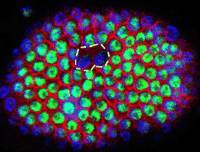 We are studying the Notch function in the development of Drosophila oogenesis, which provide an excellent model system to study how developmental signals regulate the cell cycle programs and cell differentiation. Follicle cells, forming a single layer covering the germline cells in each egg chamber, switches from the normal mitotic cycle to the endoreplication cycle at around stage 6/7, and Notch signaling is reported to be required for this switch. Using genetic manipulation, we have found, for the first time, that Notch controls the cell cycle genes through down-regulation of the expression of a homedomain gene, cut. Thus,cut acts as a linker between a developmental signal and cell cycle regulators. For detailed information, please see Sun and Deng, 2005. Because of the novelty and contribution to the field, this paper was featured in “in this issue” in Development and reported by FSU newsletter and other medical-related websites. The poster presenting the Cut function also won the first-prize poster award in the 2005 Society for Developmental Biology southeast regional meeting at Athens, GA. We are studying the Notch function in the development of Drosophila oogenesis, which provide an excellent model system to study how developmental signals regulate the cell cycle programs and cell differentiation. Follicle cells, forming a single layer covering the germline cells in each egg chamber, switches from the normal mitotic cycle to the endoreplication cycle at around stage 6/7, and Notch signaling is reported to be required for this switch. Using genetic manipulation, we have found, for the first time, that Notch controls the cell cycle genes through down-regulation of the expression of a homedomain gene, cut. Thus,cut acts as a linker between a developmental signal and cell cycle regulators. For detailed information, please see Sun and Deng, 2005. Because of the novelty and contribution to the field, this paper was featured in “in this issue” in Development and reported by FSU newsletter and other medical-related websites. The poster presenting the Cut function also won the first-prize poster award in the 2005 Society for Developmental Biology southeast regional meeting at Athens, GA.
In addition, we have recently found Notch activates the expression of a zinc-finger protein Hindsight (Hnt) in follicle cells during endocycle stages. Hnt mediates the role of Notch in regulation of the mitotic cycle/endocycle switch through suppressing the expression of the homeobox gene cut, the Cdc25 phosphatase, string, and the Hh signaling pathway by transcriptional suppression of cubitus interruptus, all of which promote follicle cell proliferation in early oogenesis. Thus Hnt bridges the two important developmental signaling pathways, Notch and Hh, in follicle cell-cycle switch and cell differentiation. These data were published in Developmental Cell (March, 2007). It was also highlighted in the Nature Reviews Genetics (01 Apr. 2007) and Science’s STKE (13 March 2007).
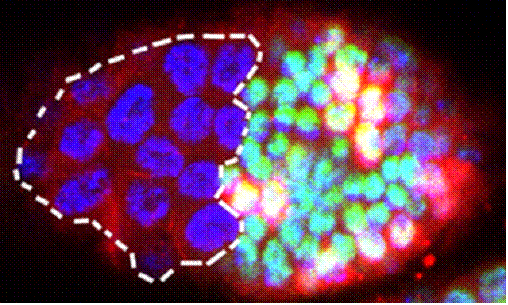
Cut mutant follicle cells

Overexpression of Hnt in the follicle cells. |
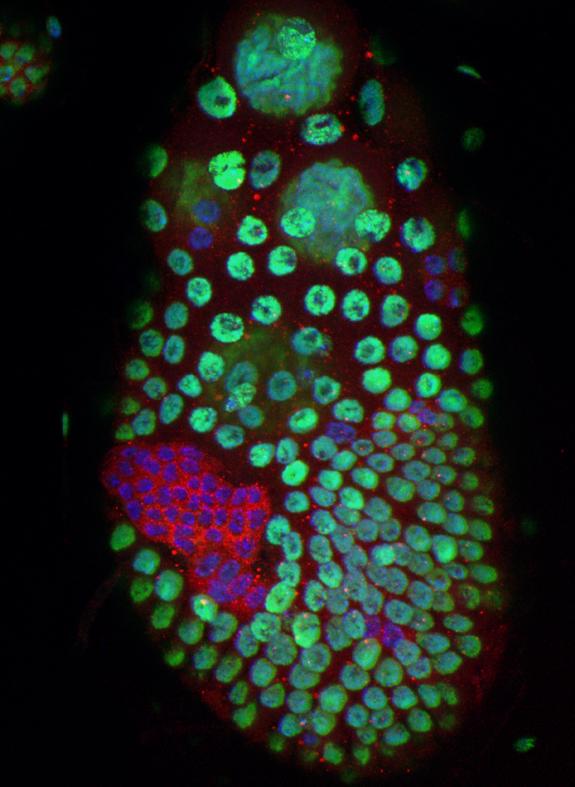
Hnt mutant follicle cells |
| |
|
|





